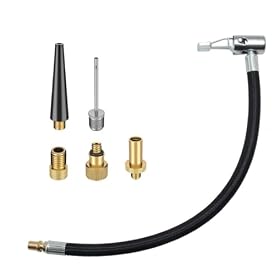
The best floor pump for a small apartment closet is compact enough to store vertically or in a narrow gap, but still stable and easy to use. Focus on folded dimensions, hose storage, valve compatibility, gauge readability, and the pressure your tires require.
Best floor pump for a small apartment closet
A good floor pump for a small apartment should store easily without giving up the stability and leverage that make floor pumps faster than mini pumps. Prioritize the pump’s stored height and footprint, a hose that can be secured neatly, a head that fits your valve type, and a readable gauge positioned where you can see it while pumping.
What makes a floor pump apartment-friendly?
A floor pump does not need to be extremely small when in use. It needs to be easy to put away afterward. Before buying, check the manufacturer’s listed dimensions for the pump in its storage position—not just its working height.
Look for these characteristics:
A narrow footprint: This makes it easier to store beside a bookcase, in a hall closet, or between a wall and a cabinet.
A manageable stored height: A tall pump may not fit under a shelf or inside a short closet section.
Secure hose storage: A hose hook, channel, or clip prevents the hose from dangling and taking up extra space.
A foldable or low-profile handle: Some designs reduce the space needed around the pump when stored.
A stable base: A pump that is too small or light can be frustrating to use, especially at higher pressures.
A readable gauge: A gauge placed near the base or handle is easier to check without moving the pump.
Do not choose based on the smallest listed dimensions alone. A very compact pump may have a smaller base, shorter barrel, or less comfortable handle. Those tradeoffs can matter more than saving a few inches in a closet.
Key features to compare
Stored dimensions and hose management
Measure the intended storage space first. Leave room to remove the pump without scraping nearby items, and account for the hose and handle if they do not fold or clip securely.
A pump with integrated hose storage is usually more convenient in a small home than one whose hose must be wrapped loosely around the body. If you plan to keep the pump in a drawer or low cabinet, compare the folded length and width rather than the operating height.
Valve compatibility
Most bicycle tubes use either Presta or Schrader valves. A pump may support both through a dual-purpose head, a reversible insert, or separate valve settings. Check the instructions before switching modes; forcing a valve head onto the wrong setting can damage the valve or create an air leak.
If you regularly inflate bikes with different valve types, a head that changes between Presta and Schrader without loose parts is generally easier to keep organized. A separate Presta adapter can also work, but it adds one more small item to store.
Pressure range and gauge scale
The pump’s maximum pressure should exceed the recommended pressure of your tires, but maximum pressure is not the only specification that matters. Gauge accuracy and scale readability are more useful for routine inflation.
A road tire often needs more pressure than a mountain-bike tire, while many hybrid, commuter, and children’s bike tires fall between those categories. Use the pressure range printed on the tire sidewall or specified by the tire manufacturer. Do not automatically inflate to the pump’s maximum rating.
For lower-pressure tires, a gauge with clear markings in the range you use is preferable to a very high-range gauge with cramped low-pressure increments. For high-pressure road tires, confirm that the pump is designed for that pressure and that the hose and head lock securely onto the valve.
Base and handle design
Compact storage should not mean an unstable pumping platform. A broad, rigid base and a comfortable handle make it easier to apply force without the pump rocking across the floor.
Consider where you will use it. Hard floors may expose slipping or wobbling, while carpet can make a narrow base feel less stable. A folding handle saves storage space, but verify that it locks firmly in the operating position.
Hose length
A longer hose gives you more flexibility to position the bike and pump, especially in a narrow apartment or shared room. However, excess hose can be harder to store if there is no built-in retention system.
A practical setup lets you place the pump on the floor while keeping the bike’s valve in a comfortable position. If the bike must remain mounted on a wall rack, hose reach becomes more important than it would be when the bike is standing on the floor.
Product prices and availability are accurate as of the date/time indicated and are subject to change. Any price and availability information displayed on Amazon.com at the time of purchase will apply to the purchase of this product.
Compact floor pump versus mini pump
A mini pump takes less storage space and is useful for roadside emergencies, but it usually requires more strokes and more effort to inflate a tire. It may also be harder to read accurately if its gauge is small or absent.
A compact floor pump is usually the better primary pump for an apartment if you inflate tires at home regularly. It offers better leverage, a more stable stance, and faster inflation. A mini pump can remain in a saddlebag or backpack as a backup rather than replacing the floor pump entirely.
Product prices and availability are accurate as of the date/time indicated and are subject to change. Any price and availability information displayed on Amazon.com at the time of purchase will apply to the purchase of this product.
Compact floor pump versus CO2 inflator
A CO2 inflator is extremely portable and can reinflate a tire quickly after a puncture. It depends on disposable cartridges, provides limited total inflation, and requires careful control because the cartridge empties quickly.
For routine home maintenance, a floor pump is easier to use and does not require replacement cartridges. A CO2 inflator makes more sense as an emergency road accessory than as the only pump in an apartment.
Buying checklist
Before choosing a model, verify:
Its stored height, width, and depth fit your closet or cabinet.
The head supports the valve type on your bike.
The pressure range covers your tires with useful gauge markings.
The hose can be clipped, wrapped, or otherwise contained.
The base is stable on the floor where you will use it.
The handle is comfortable and locks securely if it folds.
Replacement seals, valve-head parts, or gauge components are available if the manufacturer offers them.
How to avoid common apartment-storage problems
Keep the pump upright or in the position recommended by the manufacturer. Avoid storing it where the hose is sharply kinked, the gauge is pressed against a hard edge, or the valve head can be struck by other objects.
If the pump is kept in a shared closet, mark the valve setting or keep any loose adapters in a small labeled pouch. This prevents a minor setup problem from turning into a damaged Presta valve or a lost adapter.
When a compact floor pump is not the right choice
Choose a standard full-size floor pump if you have enough storage space and value maximum stability or frequent high-pressure inflation. Choose a mini pump if storage space is exceptionally limited and you mainly need an emergency backup. Choose a floor pump plus a compact roadside pump if you want convenient home inflation and repair preparedness away from home.
If a floor pump leaks at the head, loses air around the hose, or becomes difficult to operate, inspect the valve connection and hose first. Replace worn seals or a replaceable pump head when parts are available. If the barrel, base, gauge, or handle is damaged—and replacement parts are unavailable—a new pump is usually more sensible than repairing the main body.
FAQ
What size floor pump fits in a small apartment closet?
There is no universal best size because closet shelves and gaps vary. Measure the available height, width, and depth, then compare those measurements with the pump’s stored dimensions, including the handle and hose.
Is a compact floor pump stable enough for high-pressure road tires?
Some are, but compact dimensions can reduce base size or leverage. Check the manufacturer’s pressure rating and look for a rigid base, secure handle, and valve head designed for the pressure your tires require.
Do I need a pump with a separate Presta adapter?
Not necessarily. A pump with a dual-purpose head may handle Presta and Schrader valves directly. An adapter is useful when a pump supports only Schrader connections, but it adds a small part that can be misplaced.
Is a mini pump better than a floor pump for apartment storage?
A mini pump takes less space, but it generally requires more effort and time for home inflation. A compact floor pump is usually the better primary option when you inflate tires at home, while a mini pump works well as a travel backup.
Should I buy a pump with the highest possible pressure rating?
No. The rating should exceed your tire requirements, but gauge readability, stability, and valve compatibility are often more important. Follow the pressure guidance printed on the tire or provided by the tire manufacturer.