Gas-station air can inflate a bike tire in a pinch, but it is not a dependable replacement for carrying a pump. The main risks are an incompatible valve chuck and adding too much air too quickly. If you use a station compressor, check the tire’s pressure guidance, use a separate gauge if needed, and inflate in short bursts.
Comparisons · Tue Sep 22
Gas station air as an alternative to carrying a pump
A gas-station compressor can be a backup for some bike tires, but it is not as controlled or reliable as a bike pump. Check your valve, use a gauge, and add air in short bursts.
When gas-station air can work
A station compressor is most practical for a tire with a Schrader valve, the wider valve commonly used on car tires. Many air hoses are designed for Schrader valves and may not seal on a bike’s Presta valve, which is narrower and has a small locking nut at the tip. A Presta-to-Schrader adapter may help, but the station chuck still needs to fit and hold a seal.
It is more useful when you are near a station and need to top off a tire than when you need a predictable, portable way to inflate a bike. Station equipment varies: the hose may be awkward to hold, the gauge may be hard to read, and the compressor may deliver air faster than you expect.
Portable option for roadside inflation
 Vibrelli Mini Bike Pump - Presta & Schrader Bicycle Pump - 120 PSI Tire Pump…Vibrelli
$16.98 as of
View on Amazon Aluminum Alloy Mini Bike Pump - Portable Lightweight Cycle Pump for Presta & Schrader Valve,…West Biking
$9.99 as of
View on Amazon BV Mini Bike Pump Portable Frame Pump, 120PSI High Pressure - Smart Valve Fits Presta…BV
$11.99 as of
View on Amazon
Product prices and availability are accurate as of the date/time indicated and are subject to change. Any price and availability information displayed on Amazon.com at the time of purchase will apply to the purchase of this product.
How to use a station compressor more safely
- Check your tire’s pressure guidance. Use the pressure range on the tire or the bicycle or tire manufacturer’s instructions. Do not assume a bike tire should be inflated to a car-tire pressure.
- Confirm the valve type. For a Presta valve, loosen the small tip nut before attaching an appropriate adapter. Remove the adapter afterward and retighten the tip nut gently.
- Use a reliable pressure gauge. A station gauge can be difficult to control or inaccurate. If you cannot check the pressure, avoid using a high-powered compressor on a narrow or high-pressure tire.
- Inflate in short bursts. Keep the chuck steady, add a little air, then check the pressure. Stop at the appropriate pressure for your tire and riding setup; do not treat the tire’s maximum marking as the target in every situation.
- Check for leaks and damage. If the tire is visibly damaged, will not hold air, or has come off the rim, do not try to solve the problem by adding more air. Inspect it or get help before riding.
Never leave the compressor connected while you walk away. If the tire begins to bulge, the bead shifts, or you hear air escaping, stop immediately. Follow the station’s instructions and do not force a chuck or adapter that does not fit.
Compact emergency inflation option
 BriskMore CO2 Inflator Kits with 5 X 16g CO2 Cartridges for Bike Tires, Presta and…BriskMore
$23.99 as of
View on Amazon BriskMore Black CO2 Inflator Presta and Schrader Valve Compatible Bicycle Tire Pump for Mountain and…BriskMore
$13.90 as of
View on Amazon Ctrepower CO2 Bike Tire Inflator - Push-Button CO2 Bike Pump for Roadside Repairs - Presta…Ctrepower
$29.89 as of
View on Amazon
Product prices and availability are accurate as of the date/time indicated and are subject to change. Any price and availability information displayed on Amazon.com at the time of purchase will apply to the purchase of this product.
Why a bike pump is usually the better choice
A bike floor pump or mini pump is designed to connect to common bike valves and gives you more control over inflation. A floor pump is convenient for regular use at home; a mini pump is easier to carry on a ride. A CO₂ inflator can be compact for emergencies, but it provides a limited number of inflations and requires compatible cartridges and an inflator head.
For an occasional top-off near a station, air may be a workable backup if you can control and check the pressure. For a ride where a flat could leave you stranded, carry a pump or another inflation option that works with your valve. If you regularly need to inflate tires and have no dependable way to check pressure at the station, a bike pump with a suitable gauge is the more practical choice.
Adapter for Presta valves at Schrader-style air stations
 MEAJOO 2PCS Brass Presta Valve Adapter, Convert Presta to Schrader Adaptor, Inflate Tire Using Standard…MEAJOO
$3.99 as of
View on Amazon Bike Bits Brass Presta Valve Adapter - Convert Presta to Schrader, 4 PackBike Bits
$5.97 as of
View on Amazon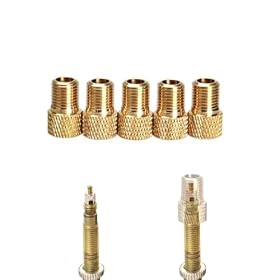 5 Pack Brass Presta Valve Adaptor, Schrader to Presta Bike Pump AdapterJuscycling
$5.95 as of
View on Amazon
Product prices and availability are accurate as of the date/time indicated and are subject to change. Any price and availability information displayed on Amazon.com at the time of purchase will apply to the purchase of this product.
FAQ
Can I use a gas station air pump on a Presta valve?
Usually, you need a Presta-to-Schrader adapter, and the station chuck must fit the adapter securely. Inflate in short bursts and check the pressure with a reliable gauge.
Can a gas station compressor overinflate a bike tire?
Yes. A compressor can add air quickly, and its gauge may be difficult to control or inaccurate. Use short bursts, check pressure frequently, and follow the tire or manufacturer’s pressure guidance.
Should I rely on gas-station air instead of carrying a pump?
Not for most rides. Stations may be far away, closed, or incompatible with your valve. A suitable mini pump or other portable inflation option is more dependable in an emergency.
Is a gas station tire gauge accurate enough for a bike?
Not necessarily. Station gauges vary, and some are awkward to read or use. For a precise setting, use a bike pump or a separate gauge suited to your tire’s pressure range.