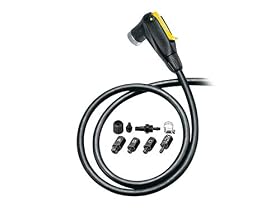
Threaded Presta pump heads screw onto the valve for a secure connection; press-fit heads push on for faster attachment. Your best choice depends on convenience, valve condition, and how carefully you want to handle the connection.
How the two pump heads connect
A threaded Presta pump head screws onto the threaded section of the valve stem. A press-fit head pushes over the valve and usually locks in place with a lever or a snug internal seal. Both can inflate a Presta tire effectively when the head is compatible and its seal is in good condition.
The choice is mainly about attachment and removal: threaded heads emphasize a firm connection, while press-fit heads are generally quicker to use.
Threaded Presta: secure, but take care when unscrewing
A threaded connection can feel reassuringly stable while you pump. It is less likely to come loose from a bump or a pull on the hose, which can be useful with a stiff hose or when pumping at an awkward angle.
The trade-off is that you have to screw the head on and off. Turn it gently, and avoid rotating the valve stem. If the valve has a removable core, excessive twisting can loosen the core along with the pump head. If the head feels stuck, stop rather than forcing it.
Choose threaded if you value a firm connection and are comfortable attaching and removing the head carefully. Check that your pump head fits the valve stem and follow the pump maker’s instructions.
Product prices and availability are accurate as of the date/time indicated and are subject to change. Any price and availability information displayed on Amazon.com at the time of purchase will apply to the purchase of this product.
Press-fit: faster to attach, sensitive to seal condition
A press-fit head is usually faster to attach and remove, making it convenient for regular use or roadside stops. A locking lever helps hold the head in place; some designs rely more on the fit of the internal seal.
A press-fit head can leak or slip if its seal is worn, dirty, or the wrong size. Push it on straight and avoid rocking it from side to side. Side pressure can bend a valve stem, especially if the stem is long or unsupported.
Choose press-fit if speed and simple operation matter most, and the head fits your valve securely without needing excessive force.
Product prices and availability are accurate as of the date/time indicated and are subject to change. Any price and availability information displayed on Amazon.com at the time of purchase will apply to the purchase of this product.
Which should you choose?
Consideration
Threaded head
Press-fit head
Attachment
Screws onto the valve
Pushes onto the valve, often with a locking lever
Convenience
Takes a little longer to attach and remove
Usually quicker
Connection feel
Firm when properly installed
Depends on the fit and condition of the seal
Main caution
Avoid twisting or loosening a removable valve core
Keep the head straight to avoid stressing the stem
For a home floor pump, either type can work well. Prioritize a head that fits your valves reliably, seals without excessive force, and is easy to operate with the hose position you have. For a travel pump, consider how quickly you can connect it and whether its hose reduces sideways force on the valve.
If you regularly inflate both Presta and Schrader tires, check whether the pump head supports both valve types or requires a separate adapter. A Presta adapter may help in some situations, but it does not change whether the pump head itself uses a threaded or press-fit connection.
Product prices and availability are accurate as of the date/time indicated and are subject to change. Any price and availability information displayed on Amazon.com at the time of purchase will apply to the purchase of this product.
Check the setup before blaming the pump head
Before inflating a Presta tire, remove the dust cap and loosen the small knurled nut at the valve tip until it stops; do not remove it. Connect the head according to the pump instructions. After pumping, remove the head gently and retighten the tip nut.
If air escapes at the connection, reseat the head straight and check that the valve is open. Persistent leakage may point to a worn pump-head seal, a poor fit, or a damaged valve. Replace a worn seal or head if the pump maker offers the correct part. If the head repeatedly slips, leaks, or risks damaging the valve despite correct setup, replacing the pump may be more practical.
FAQ
Can a threaded Presta pump head damage a valve?
It can cause problems if you overtighten it or twist the valve while removing the head. Use gentle turns and take extra care with a valve that has a removable core.
Is a press-fit Presta pump head less reliable?
Not necessarily. A well-fitting press-fit head with a sound seal can work reliably. Leaks or slipping often indicate a worn seal, incorrect fit, or a head that is not seated straight.
Do I need to unscrew the small nut on a Presta valve before pumping?
Yes. Loosen the small nut at the valve tip until it stops before connecting the pump. Do not remove the nut; retighten it after inflation.
Can I use a Presta adapter with either type of pump head?
A Presta-to-Schrader adapter can let a Presta valve connect to a Schrader-style pump head. Check that the pump and adapter are compatible and follow their instructions.