There is no single PSI that suits every road tire. As a rough starting point on paved roads, many average-weight riders begin around 70–85 PSI for 25 mm tires, 60–75 PSI for 28 mm tires, and 50–70 PSI for 30–32 mm tires. These are only starting ranges: your weight, tire construction, rim, and riding surface can change the right pressure substantially.
Pressure · Fri Sep 18
What PSI a Road Tire Needs
Road tires do not have one correct PSI. Tire width, total riding weight, surface, and your tire and rim limits all matter.
Check the tire and rim limits
Read the pressure guidance on the tire and in the rim or wheel manufacturer’s instructions. Stay within the stated limits for both. If their guidance differs, follow the more restrictive limit and check with the manufacturer if you are unsure.
The maximum PSI printed on a tire is a limit, not a recommended target. Some rims—particularly hookless designs—have specific tire-compatibility and pressure requirements. Do not exceed them, even if the tire itself lists a higher maximum.
Inflate tires at home and check pressure as you go
 BV Bike Pump out of durable Steel - Bicycle pump 160 PSI high Pressure, Bike…BV
$23.99 as of
View on Amazon BV Bicycle Ergonomic Bike Floor Pump with Gauge & Smart Valve Head, 160 psi, Automatically…BV
$31.99 as of
View on Amazon Topeak JoeBlow Sport III High-Pressure Bike Floor Pump – 160 PSI, Durable Steel Barrel, 3”…Topeak
$69.95 as of
View on Amazon
Product prices and availability are accurate as of the date/time indicated and are subject to change. Any price and availability information displayed on Amazon.com at the time of purchase will apply to the purchase of this product.
Choose a starting pressure
Use the tire’s measured width, if you can check it, rather than relying only on the size printed on the sidewall. The same labeled tire can measure differently on different rims.
As a general rule, wider tires usually need less pressure than narrower ones. More rider and cargo weight usually calls for more pressure; the rear tire often needs a little more than the front because it carries more weight. Rough pavement can also feel better and provide better grip at a somewhat lower pressure than very smooth pavement.
Tubeless tires can often run lower than comparable tires with tubes, but do not assume that is safe for every setup. Too little pressure can cause the tire to squirm, burp air, or strike the rim. With tubes, very low pressure increases the chance of pinch flats.
Check tire pressure with a separate gauge
 Topeak SmartGauge D2 Digital Tire Pressure Gauge – Presta/Schrader Compatible, 250 Psi/17 Bar, Precision Air…Topeak
$35.45 as of
View on Amazon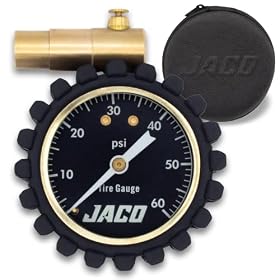 JACO MBX-60 Presta Tire Pressure Gauge for Bikes (Max 60 PSI) | MTB & XC…JACO Superior Products
$22.90 as of
View on Amazon JACO RDX-160 Presta Tire Pressure Gauge for Bikes (10-160 PSI) | Road Bike & BMX…JACO Superior Products
$22.90 as of
View on Amazon
Product prices and availability are accurate as of the date/time indicated and are subject to change. Any price and availability information displayed on Amazon.com at the time of purchase will apply to the purchase of this product.
Fine-tune for comfort and control
Inflate both tires to a reasonable starting point, then adjust in small steps while staying inside all tire and rim limits. If the ride feels harsh or the tires skip over rough pavement, try a small reduction. If a tire feels unstable in corners, bottoms out, or gets frequent pinch flats, add pressure and check that the tire is properly seated and in good condition.
Use a pump gauge you can read consistently, and check pressure before riding. If you change tires, wheels, or your carried load, reassess rather than reusing the old setting automatically. A bike tire pressure calculator can help narrow the starting point, but manufacturer limits and how the bike handles still take priority.
When to ask for help
If you cannot find compatible pressure guidance for your tire and rim, especially with a hookless wheel, contact the wheel or tire manufacturer or a qualified bike shop before riding. Replace a tire that is damaged, bulging, or unable to hold air; pressure adjustments will not make a compromised tire safe.
FAQ
Should road bike tires be inflated to the maximum PSI on the sidewall?
Usually not. The sidewall maximum is a limit, not a target. Choose pressure based on tire width, total riding weight, surface, and the wheel maker’s requirements, while staying within all stated limits.
Should the front and rear road tires have the same PSI?
Not necessarily. The rear tire often carries more weight, so it may need slightly more pressure. Use your tire and rim guidance, then adjust in small increments based on handling and comfort.
Do wider road tires need less pressure?
Generally, yes. A wider tire can support a given load at lower pressure than a narrower tire, but the correct setting still depends on rider and cargo weight, tire construction, and rim limits.
Does tubeless change the PSI a road tire needs?
It can. Tubeless setups often allow lower pressure than comparable tires with tubes, but too little pressure can cause instability, air loss, or rim damage. Follow the tire and wheel manufacturers’ guidance.