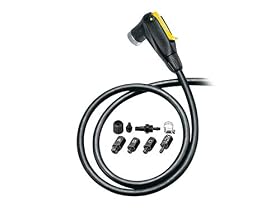
If your bike pump hose is too short to reach a valve while the bike is on a work stand, first reposition the pump and inspect the hose routing. If that does not provide enough slack, a longer replacement hose or a different pump is usually the practical fix.
A bike pump hose that is too short on a work stand is usually caused by pump placement, hose routing, or a hose that was designed for floor-level use. Move the pump closer to the bike, keep the hose free of sharp bends, and check that the pump head is fully seated on the valve. If the hose still cannot reach without pulling on the valve, use a longer replacement hose or a pump with a longer flexible hose rather than forcing the connection.
Check the pump's position first
Place the pump on a stable surface directly below or beside the work stand. Avoid leaving it several feet away on the floor, especially if the bike is raised high or the stand has a wide base.
The pump should remain upright and stable while you operate the handle. Do not balance it on the stand, a bike frame tube, or another unstable surface. If the pump has a hose that exits from one side, rotate or reposition the pump so the hose points toward the bike instead of making a sharp turn.
For a quick check, lower the bike or move the pump temporarily. If the hose reaches when the pump is close to the stand, the pump itself may be fine; the setup simply needs a shorter distance between the pump and valve.
Inspect the hose and connections
Look along the full hose length for:
Tight bends or kinks
A hose trapped under the pump base or stand
Cracks, splits, or bulges
A loose connection where the hose enters the pump
A threaded or push-fit connection that is not fully seated
A damaged hose can become shorter in practice because the usable section is stiff or kinked. Do not stretch it to compensate. A hose that is under tension can pull sideways on the valve or cause the pump head to detach.
If the hose is removable, check the pump manufacturer's instructions before ordering a replacement. Hose threads and end fittings are not universal, and a hose that appears to fit may leak or fail to lock securely.
Product prices and availability are accurate as of the date/time indicated and are subject to change. Any price and availability information displayed on Amazon.com at the time of purchase will apply to the purchase of this product.
Check the pump head and valve position
Make sure the pump head is attached to the correct valve type and locked according to the pump instructions. Presta and Schrader valves use different openings or settings on many pump heads. A head that is incorrectly configured may require extra force, making a short hose seem even more difficult to use.
Before attaching the pump:
Remove the valve cap.
For a Presta valve, loosen the small tip nut without removing it.
Keep the valve stem as straight as practical.
Attach and secure the pump head without twisting the stem.
Pump with the hose making a gentle curve rather than a tight sideways pull.
If the valve sits deep inside an aerodynamic rim or the stem is unusually short, the hose may technically reach but still be difficult to use. A compatible valve extender may help in some cases, but confirm that it matches the valve and rim setup. Do not use an extender as a substitute for a secure pump connection.
Product prices and availability are accurate as of the date/time indicated and are subject to change. Any price and availability information displayed on Amazon.com at the time of purchase will apply to the purchase of this product.
Adjust the work stand or bike position
A raised bike can put the valve much farther from the floor than expected. Depending on the stand, you may be able to lower the clamp height, rotate the bike, or reposition the frame so the wheel and valve are closer to the pump.
Take care when rotating or lowering a clamped bike. Follow the stand's instructions, keep the bike balanced, and do not exceed its weight or clamping limits. Avoid clamping thin, fragile, or unsupported frame sections unless the stand manufacturer specifically allows it.
Rotating the wheel so the valve is at the lowest accessible point can reduce the reach required. However, do not pull the hose across spokes, rotors, chainrings, or other moving parts. For a bike with hydraulic disc brakes, avoid leaving it in a position that the brake manufacturer warns against.
Product prices and availability are accurate as of the date/time indicated and are subject to change. Any price and availability information displayed on Amazon.com at the time of purchase will apply to the purchase of this product.
Decide whether the hose needs replacement
A longer hose is the simplest solution when the pump works correctly but cannot reach the valve from a safe, stable position. Look for a replacement hose specifically listed for your pump family. Compare the hose-end connection, pump-side fitting, and pump-head connection before buying.
A replacement hose is reasonable when:
The original hose is cracked, kinked, or stiff
The pump head works properly but the hose lacks reach
The pump has a serviceable, user-replaceable hose
The pump body and gauge still operate normally
Replacing the entire pump is usually more practical when the hose is permanently attached, replacement parts are unavailable, or the pump head, gauge, or seals are also failing. For home maintenance, a floor pump with enough hose length to reach a raised bike is generally more convenient than repeatedly repositioning a short hose.
Do not force a short hose
Avoid stretching the hose until it pulls the valve sideways. Excessive force can damage a Presta valve stem, loosen a valve-core assembly, detach the pump head, or make the bike unstable on the stand. Never let the hose catch on the wheel or drivetrain while the wheel is turning.
If the bike is clamped high and the pump cannot be placed close enough, lower the bike or use a longer hose. If you are unsure whether the stand is safely positioned or whether a damaged valve or rim has been affected, stop and consult the stand or pump manufacturer instructions, or ask a qualified bike mechanic to inspect it.
Quick decision guide
The hose reaches when the pump is moved: Keep the pump beside the stand on a stable surface.
The hose is kinked or damaged: Replace the hose if the pump supports replacement parts.
The head will not attach securely: Check the Presta/Schrader setting and pump-head seal.
The valve is hard to reach because of the stand height: Lower or rotate the bike according to the stand instructions.
The hose remains too short from a safe position: Buy a compatible longer hose or replace the pump with one designed for greater reach.
FAQ
Can I use a hose extension on a bike pump?
Only if the pump manufacturer supports that connection or the extension is specifically compatible with the pump and head. Improvised hose extensions can leak, separate under pressure, or use fittings that do not seal correctly.
How long should a bike pump hose be for a work stand?
There is no single required length because stand height, wheel size, and pump placement vary. The hose should reach the valve with slack while the pump stays upright on a stable surface and the hose does not cross the drivetrain or pull sideways on the valve.
Why does the hose reach the front wheel but not the rear wheel?
The rear valve may be farther from the pump because of the stand position, frame geometry, or wheel orientation. Move the pump closer, rotate the wheel so the valve is accessible, and route the hose around—not through—the frame and drivetrain.
Should I buy a mini pump instead?
A mini pump can solve a reach problem because it is held close to the valve, but it usually takes more strokes and may be less convenient for high-pressure road tires. For regular home inflation on a work stand, a floor pump with adequate hose length is usually the easier option.