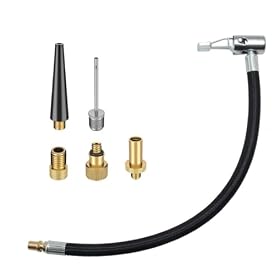
A Presta-to-Schrader adapter lets a pump designed for Schrader valves inflate many tires with Presta valves. Here is what to check before buying and how to use one without causing leaks or damaging the valve.
A Presta-to-Schrader adapter is the simplest way to use a Schrader-only pump on a bike tire with a Presta valve. The small threaded adapter screws onto the Presta valve after you loosen its valve core, creating an outside shape that a Schrader pump head can grip.
What to check before buying
Confirm that your pump is Schrader-only
Some floor pumps have a dual valve head or a reversible insert that already supports Presta and Schrader valves. If yours does, an adapter is unnecessary. Check the markings on the pump head or its manual before buying.
A pump that accepts only Schrader valves usually has a chuck opening sized for the wider automotive-style valve. The adapter provides the missing interface; it does not change the pump itself.
Check the Presta valve’s threads
The adapter needs to screw onto the external threads near the top of the Presta valve. Most standard Presta valves have these threads, but inspect the valve before ordering. Avoid forcing an adapter onto damaged or badly bent threads.
The adapter is intended for a conventional Presta valve with a manually operated center pin. It may not be appropriate for unusual valve designs or accessories that cover the threaded section.
Match the adapter to the pump connection
Most Presta-to-Schrader adapters use the same general Schrader-style connection, but pump heads vary. A clamp-style head should lock around the adapter, while some screw-on heads may require a specific shape or enough exposed thread to engage correctly.
If your pump uses a proprietary connector, verify compatibility with the pump manufacturer rather than assuming every adapter will fit.
How to use a Presta adapter
Remove the dust cap from the Presta valve.
Unscrew the small brass valve nut several turns. Do not remove the nut completely.
Briefly press the valve core to confirm that the valve opens. A short hiss is normal.
Screw the adapter onto the Presta valve by hand. Tighten it gently; it only needs to seal, not be forced.
Inflate the tire while watching the pump gauge if the gauge is suitable for the pressure range you need.
Release the pump head carefully so the adapter does not unscrew with it.
Remove the adapter, then tighten the small Presta valve nut and replace the dust cap.
If air escapes continuously around the adapter, stop pumping and inspect the valve threads, adapter seating, and pump chuck. Do not keep forcing air into a connection that is visibly leaking.
Basic adapter for occasional home or emergency use
Product prices and availability are accurate as of the date/time indicated and are subject to change. Any price and availability information displayed on Amazon.com at the time of purchase will apply to the purchase of this product.
What an adapter can and cannot do
A Presta adapter changes the valve connection, not the pump’s performance. The pump still has the same hose, piston, gauge, and pressure capability it had before.
The adapter also does not make a low-pressure pump suitable for every high-pressure road tire. Check the tire sidewall and the pump’s stated pressure capability, and stay within the limits specified by the tire, rim, valve, and pump manufacturers.
A gauge on the pump may provide a useful estimate through the adapter, but it may not be precise enough for pressure-sensitive riding. Small leaks at the valve or adapter can also make the reading unreliable. For consistent pressure, a pump with a compatible Presta head or a separate pressure gauge may be more convenient.
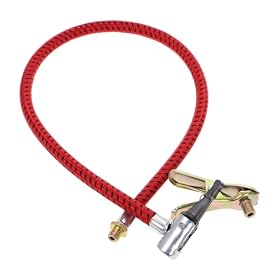
Dedicated pump alternative for regular Presta inflation
Product prices and availability are accurate as of the date/time indicated and are subject to change. Any price and availability information displayed on Amazon.com at the time of purchase will apply to the purchase of this product.
Common problems and fixes
The adapter will not screw on
Make sure the Presta valve nut is loosened but still attached. Check for dirt, cross-threading, or damaged threads. Start the adapter straight and turn it by hand. If it does not engage easily, do not use pliers; replace the adapter or have the valve inspected.
Air comes out around the valve
The adapter may not be fully seated, the Presta valve nut may still be closed, or the valve stem may be damaged. Remove the pump head, reinstall the adapter by hand, and try again. If the leak continues, replace the adapter or the tube/valve assembly as appropriate.
The pump head will not lock on
The adapter may not match the pump head, or the chuck may be adjusted for the wrong valve type. Check the pump instructions for chuck adjustment. If the head is proprietary or cannot grip the adapter securely, use a compatible pump head or a pump with a built-in Presta connection.
The adapter comes off with the pump head
The adapter may be too loose, or the pump head may be gripping it unusually tightly. Tighten the adapter by hand only enough to seal, then release the pump chuck without twisting the adapter. A different adapter or compatible pump head may be the better solution if this happens repeatedly.
The tire will not reach its intended pressure
Check for a tire, tube, valve, hose, or chuck leak first. Then confirm that the pump is rated for the required pressure and that the gauge is functioning. If the pump is difficult to use at the required pressure, replacing it with a floor pump designed for Presta valves is usually more practical than relying on an adapter.
When an adapter is the right choice
An adapter makes sense when you already own a working Schrader pump, need an inexpensive backup, or want to inflate a Presta-equipped tire occasionally. It is small enough to carry as an emergency accessory, although it can be easy to misplace.
A dedicated Presta-compatible pump is generally the better long-term choice for frequent inflation, high-pressure tires, or situations where a reliable gauge and quick connection matter. A mini pump can be more practical on the road, while a floor pump is usually easier for regular home inflation.
Before riding, remove the adapter and close the Presta valve. Leaving the adapter installed can make the valve more vulnerable to damage and may allow air loss if the connection is disturbed.
FAQ
Can I use a Schrader pump on a Presta valve without an adapter?
Usually not if the pump head accepts only Schrader valves. A dual-head or convertible pump may support both valve types without an adapter, but a Schrader-only chuck generally needs a Presta-to-Schrader adapter.
Do I need to remove the Presta valve core to use an adapter?
No. Loosen the small nut on top of the Presta valve, screw on the adapter, and leave the valve core in place. Removing the core is unnecessary for normal inflation.
Can I leave a Presta adapter on the valve while riding?
It is better to remove it after inflation and tighten the Presta valve nut. Removing the adapter reduces the chance of damaging the valve or loosening the connection.
Will a Presta adapter work with a pump gauge?
Usually the pump gauge can read pressure through the adapter, but accuracy depends on the pump, gauge, chuck, and whether the connection leaks. Use the tire and pump manufacturer limits, and consider a compatible pump or separate gauge when precise pressure matters.