Best pump for Presta and Schrader in one household
A dual-compatible floor pump is usually the simplest choice when one household has bikes with both Presta and Schrader valves. Here is what to look for, when an adapter helps, and whether you also need a mini pump.
If your household has bikes with both Presta and Schrader valves, choose a pump designed to work with both valve types without requiring a separate pump. For most home garages, a floor pump with an automatic dual-valve head is the most convenient option. A reversible or replaceable head can also work well, while a Presta adapter is a useful backup rather than the best everyday solution.
Why one pump needs to support both valve types
Schrader valves are wider and commonly found on mountain bikes, hybrid bikes, kids' bikes, and many everyday bicycles. They use a spring-loaded center pin and are similar in appearance to the valves used on car tires.
Presta valves are narrower and usually have a small threaded nut at the tip that must be loosened before inflating. They are common on road bikes and many bikes with narrower, higher-pressure tires.
The two valves are different sizes, so a standard pump head may not fit both. Before buying, check that the pump head explicitly supports both Presta and Schrader valves. A pump that only mentions a generic “bike valve” may require a closer look at its instructions or specifications.
Best all-around choice: a dual-valve floor pump
For regular inflation at home, a floor pump with a dual-compatible head is generally the best fit. It gives you a stable base, a long handle, and more leverage than a handheld pump, making it easier to inflate several bikes or reach higher tire pressures.
Look for these features:
Automatic dual-valve head: The head detects or seals around either valve type without changing internal parts.
Clear pressure gauge: An easy-to-read gauge helps you inflate each tire according to the tire or bike manufacturer's recommended pressure.
Locking lever: The lever should hold the head securely on the valve without excessive force.
Stable base: A wide, rigid base is more comfortable and safer to use than a pump that rocks while you work.
Adequate hose length: A longer hose makes it easier to reach a wheel without twisting the valve or lifting the bike.
Pressure range suited to your bikes: The pump should cover the maximum pressure specified for your tires, with some margin. Do not exceed the tire, rim, or manufacturer's stated limit.
A dual-valve floor pump is usually preferable to keeping separate Presta and Schrader pumps because it reduces clutter and makes the correct setup obvious for everyone in the household.
Product prices and availability are accurate as of the date/time indicated and are subject to change. Any price and availability information displayed on Amazon.com at the time of purchase will apply to the purchase of this product.
Automatic, reversible, and interchangeable pump heads
Not all dual-valve pumps work the same way.
Automatic dual-valve heads
An automatic head is the easiest option for a shared household. You place it on the correct valve, lock it, and inflate. These heads reduce the chance of losing a small adapter or installing an internal part incorrectly.
The tradeoff is that the sealing mechanism can wear or become less effective over time. If the head leaks around both valve types, the head gasket or entire pump head may need replacement.
Reversible heads
A reversible head uses one side or insert for Presta and another for Schrader. These pumps can be reliable, but you must use the correct side and may need to rearrange an internal washer or insert when switching valve types.
This design is a good choice if the instructions are clear and the small parts are easy to keep track of. It is less convenient for a household where several people use the pump.
Separate adapters or screw-on fittings
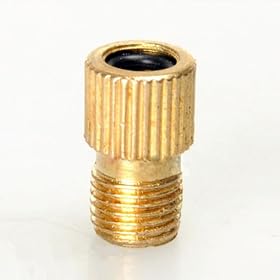
Some pumps use a standard fitting with an adapter for Presta valves. This can be inexpensive and useful as a spare, but adapters add another part to store and can be slower when inflating several tires.
Product prices and availability are accurate as of the date/time indicated and are subject to change. Any price and availability information displayed on Amazon.com at the time of purchase will apply to the purchase of this product.
Choose the pump style for where you inflate
Floor pump for home use
Choose a floor pump if you mainly inflate bikes in a garage, basement, apartment, or workshop. It is the easiest style for routine pressure checks and works well for multiple bicycles.
A floor pump is especially helpful if your household includes road tires that require more effort to inflate with a small hand pump. Match the pump's pressure capability and gauge to the requirements printed on your tire sidewalls and in the bike manufacturer's guidance.
Mini pump for roadside repairs
A mini pump is a complement to a home floor pump, not usually its replacement. It is compact enough to carry on a ride and can inflate either valve type if its head supports both or includes an adapter.
When choosing a mini pump, prioritize:
Compatibility with the valve on your bike.
A secure mount or storage method.
A size that fits your saddlebag, frame bag, or jersey pocket.
A hose or flexible connection if direct pumping could put sideways force on the valve.
A pressure and volume design appropriate for your tire size.
Small high-pressure pumps are generally better suited to narrow road tires, while higher-volume designs can be more practical for wider tires. Follow the pump manufacturer's instructions rather than assuming that a pump's maximum pressure is the ideal operating pressure for your tire.
CO2 inflator as an emergency option
A CO2 inflator is fast and compact, but it uses disposable cartridges and provides less opportunity for controlled pressure adjustment. It is best treated as an emergency or race-day tool, with a mini pump as a backup when practical.
CO2 can also lose pressure more quickly than ordinary air in some tubes. Check the tire again when you have access to a regular pump, and carry the correct cartridge size and inflator fitting for your setup.
Product prices and availability are accurate as of the date/time indicated and are subject to change. Any price and availability information displayed on Amazon.com at the time of purchase will apply to the purchase of this product.
How to use a dual-valve pump correctly
Check the tire and rim limits. Use the pressure guidance on the tire sidewall, rim, bike, or component manufacturer's instructions. Use the lower applicable limit when specifications differ.
Identify the valve. A Schrader valve is wider and has a central pin. A Presta valve is narrow and has a small tip nut.
Prepare a Presta valve. Remove the cap and loosen the small tip nut several turns. Do not remove the nut completely.
Attach the pump head straight. Avoid bending the valve, especially on a deep-section rim or a tube with a short valve stem.
Lock the lever. If the lever takes excessive force or the head leaks immediately, release it and check the selected setting or seal.
Inflate gradually. Watch the gauge and stop at the appropriate pressure. Do not use the pump's maximum rating as the target pressure.
Release the head carefully. Unlock the lever before pulling the head away. On a Presta valve, retighten the tip nut before replacing the cap.
Product prices and availability are accurate as of the date/time indicated and are subject to change. Any price and availability information displayed on Amazon.com at the time of purchase will apply to the purchase of this product.
Common problems and simple fixes
The pump head will not fit a Presta valve
Make sure the small Presta tip nut is loosened. If the pump uses a reversible head, confirm that the Presta insert is installed in the correct orientation. If it uses an adapter, attach the adapter firmly without cross-threading it.
Air leaks around the valve
Check that the head is straight and fully seated. On a reversible head, verify that the correct insert or setting is selected. A worn rubber seal can cause leaks on both Presta and Schrader valves; replacing the pump head or seal may be more practical than replacing the entire pump.
The pump works on one valve but not the other
Inspect the head for a missing insert, damaged gasket, or debris. Follow the manufacturer's instructions for switching the head between valve types. If the internal parts are loose, cracked, or no longer seal reliably, replace the head if a compatible replacement is available.
The gauge reading seems wrong
Check the connection first, since a leaking head can make inflation and gauge readings inconsistent. Compare the gauge with a known-accurate pressure gauge if precise pressure matters. If the pump gauge remains unreliable, replace the gauge or pump rather than guessing at tire pressure.
The Presta valve bends or breaks
Keep the pump head aligned with the valve and avoid pushing sideways while pumping. A hose-equipped pump can reduce strain. If the valve stem is too short for the rim or the tube has been damaged, replace the tube or consult a bike shop.
Bottom line
For one household with both Presta and Schrader valves, choose a stable floor pump with an explicit dual-valve head, a readable gauge, a secure locking lever, and a pressure range appropriate for every bike you own. Add a dual-compatible mini pump for roadside repairs. Keep a Presta adapter as a backup or for occasional use, but do not make a loose adapter the primary solution if several people regularly inflate their tires.
FAQ
Can one bike pump work with both Presta and Schrader valves?
Yes. Choose a pump whose head explicitly supports both Presta and Schrader valves. The head may be automatic, reversible, or compatible through an adapter.
Is a Presta adapter better than a dual-valve pump?
An adapter is useful as a backup or for using a Schrader-style inflator with a Presta valve. For frequent household use, a built-in dual-valve pump is usually faster and less likely to be misplaced.
Do I need a floor pump and a mini pump?
A floor pump is best for regular inflation at home, while a mini pump is useful for roadside repairs. Riders who frequently travel away from home may benefit from having both.
Can I inflate a Presta valve without loosening the tip nut?
Usually not. Loosen the small nut at the end of the Presta valve before attaching the pump, and retighten it after inflation. Do not remove the nut completely.
What pressure should I use in my bike tires?
Use the pressure guidance printed on the tire and any limits specified by the bike, rim, or component manufacturer. Do not automatically inflate to the pump's maximum rating.